

Market Size and Growth Trends
According to the latest industry data, the global market sales of pure electric sanitary vehicles reached $8.547 billion in 2024, and are expected to climb to $12.13 billion by 2031, with a compound annual growth rate (CAGR) of 5.20% from 2025 to 2031. This growth trend is not only reflected in the field of pure electric sanitary vehicles but also shows steady development throughout the entire sanitary vehicle market.
The scale of the global sanitary vehicle market is transitioning from "scale expansion" to "quality improvement." In 2025, the global urban garbage truck management system market sales had reached $114 million and are projected to grow to $191 million by 2031, with a CAGR of 9.00%. As an important category of sanitation equipment, the global income scale of compression garbage collection trucks reached 12.41 billion yuan in 2024 and is expected to approach 19.08 billion yuan by 2031, at a CAGR of 6.3%.
Regional Market Landscape
Asian Market:
As the largest market for sanitary vehicles globally, Asia contributes over 35%. The stock of sanitation vehicles in China has reached 980,000 units, with the penetration rate of new energy models jumping from 28% in 2023 to 42% in 2025. The marketization rate of sanitation services in first-tier cities has surpassed 70%, promoting the formation of specialized operation enterprise clusters.
European Market:
Driven by carbon neutrality policies, the EU's "Green Code Certification for Urban Clean Vehicles" has promoted upgrades to electric drive systems. Germany's municipal service outsourcing rate is as high as 85%, and cities like Paris in France have achieved over 90% new energy sanitation vehicle adoption.
North American Market:
The U.S. Clean Air Act and Canada's carbon tax policy have led to a surge in demand for new energy sanitation vehicles. In 2024, sales of new energy sanitation vehicles increased by 85.52% year-on-year, with the penetration rate continuously rising.
Emerging Markets: The annual compound growth rate of the Southeast Asian sanitary vehicle market reaches 8.2%, while Africa grows at 7.5%, mainly driven by accelerated urbanization and gaps in basic sanitation facilities.
Product Technology and Application Scenarios
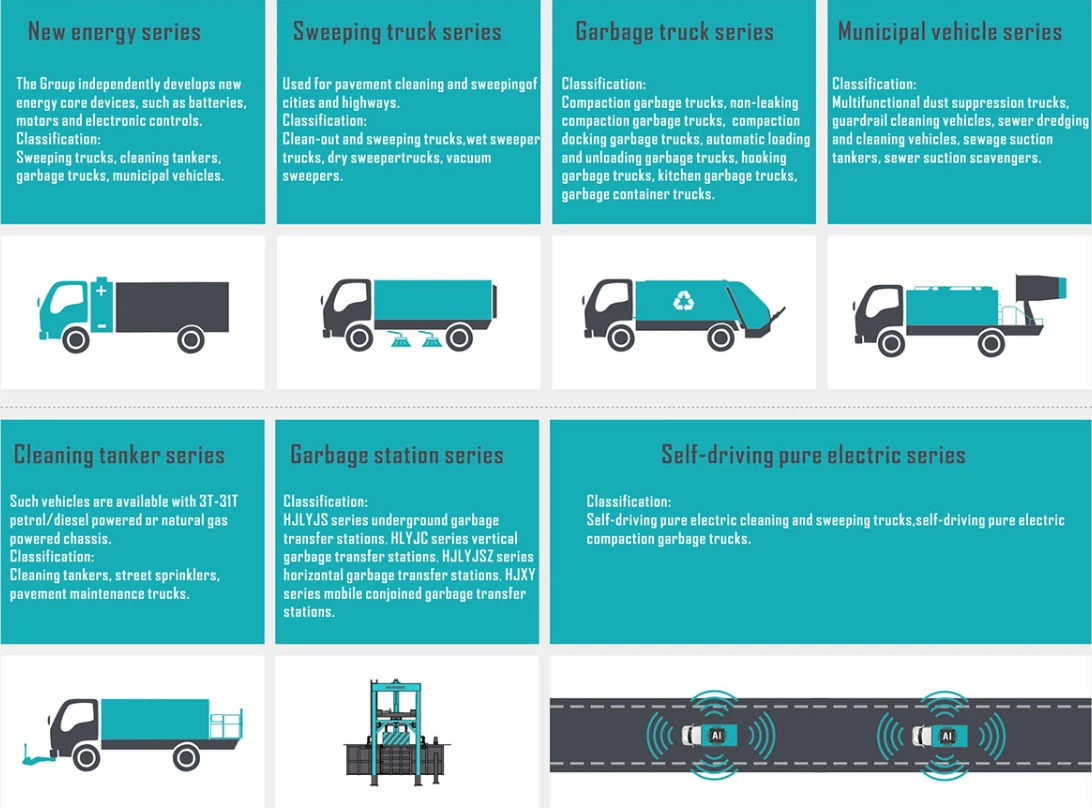
Sanitary vehicle products are evolving towards multifunctionality and intelligence:
1. New Energy: Pure electric sanitary vehicles have become mainstream due to their zero emissions and low noise advantages. In 2025, pure electric sanitary vehicles in China have taken a dominant position in the market, with a new energy sanitation vehicle penetration rate reaching 42%. Hydrogen energy sanitation vehicles account for 18%, primarily used in long-distance, heavy-load operation scenarios.
2. Intelligence: The "Development Blue Book of Low-Speed Driverless Sweeping Vehicles (2024 Edition)" indicates that in 2023, the sales scale of unmanned cleaning and sanitation in China was approximately 2.41 billion yuan, with more than 14,000 units of various unmanned sanitation vehicles and commercial cleaning robots sold. By 2025, the potential market size of unmanned sanitation services in China could reach 280 billion yuan.
3. Function Diversification: Sanitary vehicles have expanded from traditional garbage transportation to road washing, dust suppression watering, waste classification processing, and other multi-scenario applications. In 2025, large-capacity tank road washing vehicles of 9 cubic meters (such as the Yangtse series https://www.yangtseauto.com/special-vehicle/electric-road-cleaning-truck.html) became the new favorites in the market, with their high-pressure water pumps capable of achieving a maximum operating pressure of 10 MPa, significantly enhancing work efficiency with three-speed adjustment functions.
More about Yangtse sanitation vehicles
https://www.yangtseauto.com/special-vehicle/
Policy Environment and Market Changes
The policy environment is profoundly reshaping the market landscape of sanitary vehicles:
Chinese Policies: The Ministry of Finance and the Ministry of Industry and Information Technology jointly drafted the "Government Procurement Demand Standards for New Energy Vehicles," dividing the indicators for new energy sanitary vehicles into five categories such as special attributes, green indicators, and safety indicators, promoting the standardized development of the market.
EU Policies: The "Green Code Certification for Urban Clean Vehicles" requires transparency in vehicle carbon footprints, forcing export companies to upgrade their electric drive systems.
Technical Standards: The introduction of "Industry Standards for New Energy Sanitary Vehicles" promotes product technology upgrades and market standardization.
Future Outlook

The sanitary vehicle market is experiencing a transition from "cleaning tools" to "urban governance infrastructure." In the next 5 to 10 years, the global sanitary vehicle market will present three major trends:
1. Acceleration of New Energy Adoption: It is predicted that by 2030, the penetration rate of global new energy sanitary vehicles will reach 50%, with pure electric models accounting for more than 70%.
2. Intelligent Upgrades: After the maturity of L4-level autonomous driving technology, driverless sanitation vehicles will move from pilot projects to large-scale applications, with an estimated market size of 105 billion yuan by 2030.
3. Customized Services: Customized demands for different cities and scenarios will promote the development of sanitary vehicles towards modularization and functionalization.
With the deepening of "dual carbon" goals and the advancement of urbanization, the sanitation vehicle industry will accelerate towards specialization, intelligence, and sustainability. Companies need to find breakthroughs in scenario adaptability, cost control, and model innovation to gain a competitive edge in the waves of green transformation and intelligent upgrades. Sanitation vehicles are no longer simple cleaning tools but are becoming an essential part of urban smart management, contributing to the beauty and sustainable development of global cities with zero emissions, high efficiency, and intelligent features.


